
I keep saying that the Ketogenic Diet can be very simple – if you take the time to understand how you work and how Keto works.
You may be here looking for quick weight loss or a brain that is your best friend (I suggest both). You may also be looking for healthy organs and systems after a lifetime of unrestrained sugar and carbohydrate intake.
Regardless of what you are looking for, the tips I will give you today can be defining for your path and your health.
What is the Ketogenic Diet?
It is an eating plan aimed at optimizing the body and brain. Keto will work with your hormones, neurotransmitters, immune system, cell degeneration and transform the way your body works.
Ketosis, a state promoted by the Ketogenic Diet, is when your body uses fat as its primary fuel (and not sugar, as is the case with most people).
In this process, your liver will manufacture the so-called ketone bodies, energy molecules that will potentiate your body.
It can take from three days to a month to go into ketosis.
Time depends, because your body will need to burn its sugar stores until it starts using its new fuel: fat.
It is precious content to understand and maintain today’s tips. Without further ado!
8 Tips for a well done ketogenic diet
I edit: “I forgot” to put one of the main tips, which is sleep. Sleep in Ketogenic is so important, I want to make a content just about that.
Well-slept nights are CRUCIAL at Keto. Mainly, in the initial phase. Think of strategies to sleep 8 hours a night or as much as your daily routine allows.
Turn off all the lights, listen to guided meditation, take warm baths, ask your husband for a massage, increase your consumption of magnesium-rich foods and forget about cell phones and screens after the sun sets.
Get little sleep and see how you will wake up and how many ketone bodies you will have. See your state when you wake up sleeping well or sleeping poorly. Watch your weakness over the course of several days if you get it wrong.
The relationship between energy and sleep is direct and inescapable in all diets. In ketogenic, it seems to me, it is even stronger. Well, let’s get to the tips.
Support the Keto Revolution
1 – Know what you should eat
Carbohydrate reduction is the key to Keto. The simple fact of getting into ketosis has little to do with the amount of fats ingested.
Ketosis is about reducing carbohydrates to the point that the body starts using ketone bodies as fuel (no more sugar).
Your initial goal will be to reduce as much as possible. Eat between 15g and 20g of net carbs per day or between 30g and 50g of total carbs.
These carbohydrates must come from vegetables, cheese, eggs. No flour, grains or legumes.
Know that the average daily consumption is around 1.5g of protein for each kilo you weigh. So, if you weigh 70kg, you can eat something like 100g of protein a day (it’s a lot of protein).
Even so, don’t wear out counting proteins. In my video on the amount of protein in the Ketogenic Diet, I explain it very well. Be sure to watch.
If you eat four, five or six thousand calories a day, your chance of losing weight will decrease, right? If you don’t need to lose weight, watch your body.
Cook with butter, lard, ghee, coconut fat. Abuse olive oil in salads and vegetables. Cream, avocado, tahini in sauces are delicious. Eat macadamias and pecans (a handful a day or every other day). Eat fatty fish and meat.
The Law of the Ketogenic Diet
According to Dr. Stephen Phinney, Keto’s law is as follows:
Cut carbs to get ketosis. Eat protein to keep your body healthy. Consume fats until you feel full.
The theory is simple. We will try to apply it in our daily lives.
2 – Eat more fats
The initial phase of the Ketogenic Diet is the conversion phase from burning sugar to burning fat.
To achieve this state, you will basically remove all sugar (carbohydrates) from your diet.
If you don’t eat enough fat, what will happen?
Weakness, of course. You left your body without fuel!
To speed up the transformation of your body, you will increase the number of fats in the initial phase – from one to two months.
Even if it slows down your weight loss, it will speed up the conversion of fat burning.
Once you are adapted to burning fat, you can reduce the amount of fat you eat each day and let your body burn your belly, your thighs and your butt for lunch or dinner.
But, in the initial phase, you will focus on converting your body and the quantity and quality of the fuel you will eat.
What fats? The ones I already mentioned above.
3 – Supplement MCT
MCTs are powerful partners in the Ketogenic Diet. MCT stands for medium chain triglycerides. We have four components considered MCTs:
C6 (caprylic acid), C8 (caprylic acid), C10 (capric acid), C12 (lauric acid).
Each C means the length of the carbon chain (C). The longer the chain, the more your body needs to process it to generate energy.
Coconut oil, which is really fantastic, is mostly composed of lauric acid (C12). Something like 47% of coconut oil is lauric acid.
Chemists agreed that all of these carbon chains would be MCTs, but studies have pointed out relevant differences in the metabolism of each one.
C12 then becomes a long-chain triglyceride because it needs to be processed by the liver. The others don’t have to.
C6, on the other hand, is removed from products for consumption, because, in addition to the bad taste, it can give stomach and stomach problems.
Which leaves us with the two champions, the C8 and C10: pure source of energy and ketone bodies.
So, when buying your MCT, please note:
- the MCT needs to have a low amount of C12 (the more C8 and C10, the more jet power)
- need to have low amount of C6 (or it can lead to boring digestive problems)
- the MCT you bought cannot smell or taste
- must always be liquid at room temperature (store in the cupboard)
- if you are allergic to coconut, do not consume or seek MCT from other sources
The place where I buy MCT varies. I can only say that I have always used Brain Octane from BulletProof. Brain Octane is nothing more than the MCT made up of 100% C8.
To find the best store, as a good Brazilian, I go to google and type what I want, analyze prices and buy from the cheapest and most reliable place, of course. Last time, I went to the Novidade Saudável store , which had the best price. We will see in the future.
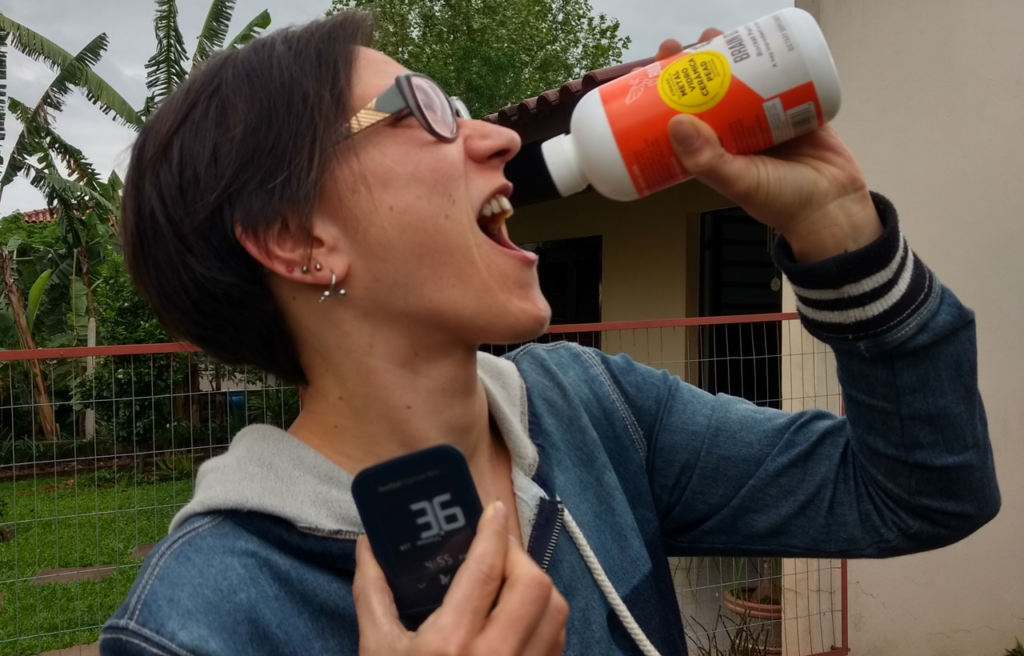 The girl in the photo, who is me, uses Brain Octane in the morning (Bulletproof brand), in coffee with cream. Pass a mug of coffee and add a spoon of MCT or Brain Octane. Start small. Consume up to four servings a day.
MCT is not just an engine for ketone bodies (mental energy). The benefits are immense and continue to grow as the studies deepen.
MCT benefits:
- increases your ability to burn calories.
- helps in controlling appetite.
- regulates blood sugar – great for diabetics.
- best friend of the brain and cognitive functions in general.
- it is rarely stored as fat.
- it is an instant source of ketone bodies – for energy, performance and resistance.
- it is a natural antiviral and antibiotic.
- helps to digest the nutrients that you will lack in the Ketogenic Diet: magnesium, calcium and amino acids.
MCT Tips:
How to use MCT? For coffee, tea, keto smoothies, salad dressing or even a neat spoonful.
When not to use MCT? Don’t cook with MCT, okay? For high temperatures, go with coconut oil or coconut fat, which will be your sources of lauric acid.
How much should I take MCT? at first, a teaspoon a day to avoid digestive problems. Increase as you feel good.
4 – Increase your salt consumption [Keto Flu ??]
If you’ve started the ketogenic diet now, you’ve spent a lifetime hearing that salt is a danger. You will need to forget this going forward.
Salt and carbohydrates together are a danger .
That’s because high carbohydrate means high insulin. When your insulin is high, your kidney begins to retain sodium.
When you enter the ketogenic diet, your insulin levels are minimal and your kidney thanks you, releasing sodium.
This seems like a small miracle in the world of hypertension. And is. Therefore, hypertensive patients must accompany their ketogenic journey with a doctor, because the drugs must be changed.
But, there is a downside to all of this.
By releasing so much water, you will release your potassium, magnesium and, of course, sodium.
The symptoms – believe me – can be terrible.
You may experience severe tachycardia, headaches, cramps, weakness, tremors and numbness, dizziness, constipation.
Do you realize that these symptoms are exactly those that people complain about at the beginning of the ketogenic diet? The Keto flu or Low Carb flu?
It is not Keto who did this to you, you who did not do Keto properly.
Is it possible to have no symptoms at all when entering Keto? Yes if you follow these tips.
I messed up. I consumed little salt and had cramps and numbness for a few days. By increasing food intake with potassium, magnesium and sodium, everything improved.
Whenever the symptoms return, I observe my nutrition. There is always a deficiency of salt and minerals. I didn’t find a website or Keto expert who wouldn’t repeat this: increase the salt in Keto.
After all, how much salt should I eat on the Ketogenic Diet?
Taking into account that you will follow the reduction of carbohydrates to the letter, your daily salt consumption should be increased to 5 grams of sodium (12 grams of salt).
5 – Eat foods rich in potassium, magnesium and calcium
As I said before, your body will release water with minerals. You won’t be able to go crazy eating meat to replace all of that.
So, what will you do? You will choose your vegetables wisely.
At the beginning of the ketogenic diet, the consumption of vegetables can be an essential factor to deal with the lack of nutrients.
I will give you the foods that are constant here at home. I chose them after extensive research.
Best Mineral-Rich Foods for the Ketogenic Diet:
- Beet leaf. I get it for free in the fruit bowl. Incredible that people put out the best part of the food.
- Spinach
- Avocado
- Almonds, walnuts and Brazil nuts
- Cabbage
- Chard
- Broccoli
Other excellent sources are meats, of course: fish like tuna and salmon, in addition to beef and chicken.
Do not forget to add the good fats at the time of preparation or meal: butter, ghee, coconut fat to prepare and olive oil at the time of serving. And put salt!
6 – Reduce your stress
I have read everything I can about the relationship between ketone bodies and cortisol (stress hormone).
After all, I started the ketogenic diet precisely to have acceptable levels of cortisol in my body. So far, I was stress in person. Explosion was my last name.
Would nutrition be able to change something that defined me since I know myself?
Yes. Understand that stress is the worst enemy of the Ketogenic Diet and any diet.
Cortisol (stress hormone) raises blood sugar levels, blocks fat burning (slimming) and, of course, takes you out of ketosis.
Cortisol inhibits the action of a regulatory neurotransmitter that is crucial to your mental health, GABA.
Instead of GABA, cortisol tells the body to produce an excitatory neurotransmitter, glutamate.
When there is too much glutamate, you are anxious, nervous, tense all the time. The mind seems to be uncontrollable and thoughts are out of focus. You may even have energy, but that energy doesn’t seem to get you anywhere.
GABA is well known among those who meditate or practice yoga. It is the neurotransmitter of focus, stability and well-being. The brain flows. Tasks are performed accurately and with as little effort as possible.
But, it is not about abolishing glutamate. We do need to be excited at different times in life. Anxiety at the right time can be wonderful.
So what we need is a balance between glutamate and GABA.
It is this harmony that will give you a brain capable of being aroused when in fact necessary (glutamate) and capable of being focused, perennial, peaceful and efficient (GABA) when necessary.
Ketone bodies help the body convert glutamate to GABA and achieve the ideal balance between the two.
Also, in your standard diet, your high carbohydrate intake required your body to produce cortisol all the time to level the toxic sugar in your blood.
You will now remove sugar and carbohydrates. You will help your body to be stable.
Guess what will happen?
You will be stable. Focused. Efficient. Quiet.
But at this early stage, you need to give yourself extra strength.
Avoid stress in the following ways:
- Get a good night’s sleep (minimum 7 hours a night. Good nights).
- Reduce insane amounts of work.
- Play with your kids.
- Stroll in the sun.
- Make love (yay!)
- Meditate or practice yoga.
- Take a deep breath whenever you can.
- Take light and peaceful walks.
- Do what you can to reduce your chronic pain.
7 – Measure your ketone bodies
The Ketogenic Diet is not just a cut in calories. It is the complete conversion of your physical and mental fuel.
Remember that your goal is to burn fat and produce ketone bodies.
How will you know if the diet is working if you don’t know how many ketone bodies you are producing?
I like to say that, in the ketogenic diet, weight loss is an inevitable result.
If you focus on the therapeutic approach, it is virtually impossible not to lose weight.
When you focus on the therapeutic approach, whether to build the most efficient brain that humans can have or simply reverse a disease, you will not go wrong with carbs.
Their motivation is much greater.
Your diet becomes a life project.
For that, you will need to produce a specific amount of ketone bodies and you will do what you can to get there.
In this process, your body will lose weight.
It is an inevitable consequence.
But along the way, questions will arise:
- Why am I not losing weight?
- Why am I out of power?
- Why am I so agitated, tense, anguished?
- Why am I doing so well?
Of course, you must analyze where you got it right too. You will measure your ketone bodies and monitor the relationship.
Ketogenic diet is to be in ketosis and there is no other way to know this if not measured.
After a month of dieting, start measuring daily.
Observe the impact of food, sleep and stress on your ketone body production. Notice your focus growing, your emotional stability settling. Note possible falls and resumes.
Master the functioning of the Ketogenic Diet in your own body.
This will give you autonomy over time. Nobody will do that for you.
How many ketone bodies do I need to produce?
8 – Feel like getting to know yourself
I will be honest with you. If you have no curiosity to understand how your body works or who you are, Keto will probably not be your Diet.
I am not aware of any diet that works for those who are not in the least interested in getting to know each other, but Keto is different.
The Ketogenic Diet is not just a calorie restriction. Ketogenic is a method to revolutionize your body and mind. Still, it challenges the status quo of diets: people will ask and even bother.
- You will need to have support.
- You will need to reduce or remove medications.
- Monitor for possible nutritional deficiencies.
- Test fasting combinations.
- You will need to cook!
- Read, research, understand the development of this new person who is who you were born to be.
Lastly, and perhaps most importantly, you will be entering a universe totally different from the current population.
You will need partners, friends, family members to help you stay motivated.
If they are absent, and will certainly be absent at some point, the best support will be their willingness to experiment, learn, evolve.
Keto is a self-connection diet. Of profound discovery.
As I say, the ketogenic diet is not a miracle or a magic pill as the title of the great movie says.
It is the engine of the most important element of a healthy body: the stable, focused, committed brain.
But even the healthiest of people will not be able to turn their lives around without motivation, support and self-interest.